Money in Thailand for Tourists (2026): Exchanging Cash, ATMs, Cards, QR Payments and VAT Refunds
By Connect Booking 9 min read
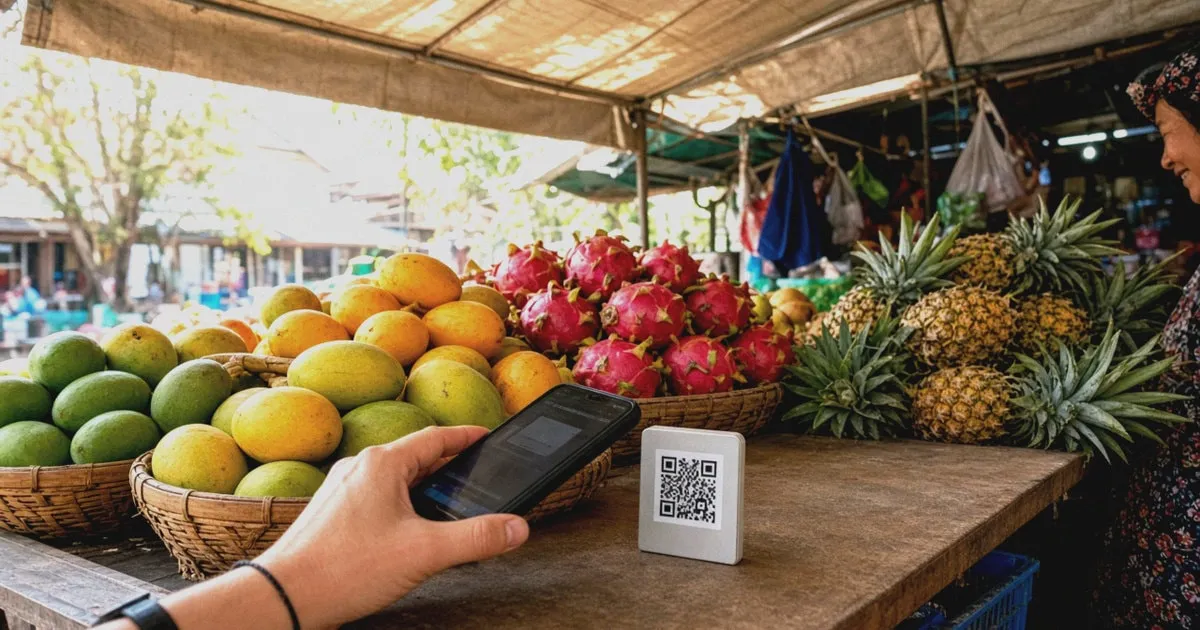
Where to exchange money in Thailand, ATM fees, cards vs cash, paying by Thai QR, tipping, and how tourists claim a VAT refund at the airport in 2026.
Thailand runs on the Thai baht (THB, ฿). In 2026 you can pay by card in hotels, malls and many restaurants, scan QR codes almost everywhere, and withdraw cash from ATMs on nearly every corner. But markets, street food and Chiang Mai's red songthaews still mostly want cash. The smart approach for most visitors: bring one or two fee-free cards, exchange a little cash in town rather than at the arrivals hall, withdraw larger amounts less often to limit ATM fees, and always choose to be charged in baht. Here are the details.
Thai baht basics
- Banknotes: 20, 50, 100, 500 and 1,000 baht. Coins: 1, 2, 5 and 10 baht (plus satang coins you'll rarely need).
- Break big notes early. Street vendors and songthaew drivers often can't change a 1,000-baht note. Use large notes at 7-Eleven, supermarkets and hotels, and keep 20s and 100s for small purchases.
- Treat banknotes with respect. They carry the image of the King, so don't step on, tear or deface money.
Where to exchange money in Thailand
You'll get the best rates at licensed money changers in town. Independent rate trackers show the gap between the best and worst money changer in a Thai city is often around 1% on any given day, and counters in airport arrival halls are usually among the worst.
- At the airport: change only what you need for a ride and your first meal. In Bangkok's Suvarnabhumi Airport, money changers on the basement level by the Airport Rail Link generally offer better rates than the arrivals hall.
- In the city: licensed exchange booths in shopping areas and bank branches. In Chiang Mai, look for changers around the Old City, Tha Phae Road and the Night Bazaar, and compare a couple of boards before you change.
- Bring your passport. Licensed money changers must record ID for each transaction. A photo on your phone is sometimes accepted for small amounts, but the original is safer.
- Bring clean notes. Large-denomination notes in good condition get the best rates; torn or marked notes may be refused.
- Never change money with people on the street.
Bringing lots of cash? You must declare foreign currency worth more than US$15,000 (or equivalent) to Thai Customs when you arrive or leave. Our Thailand entry requirements checklist covers the other customs limits.
ATMs and fees in Thailand
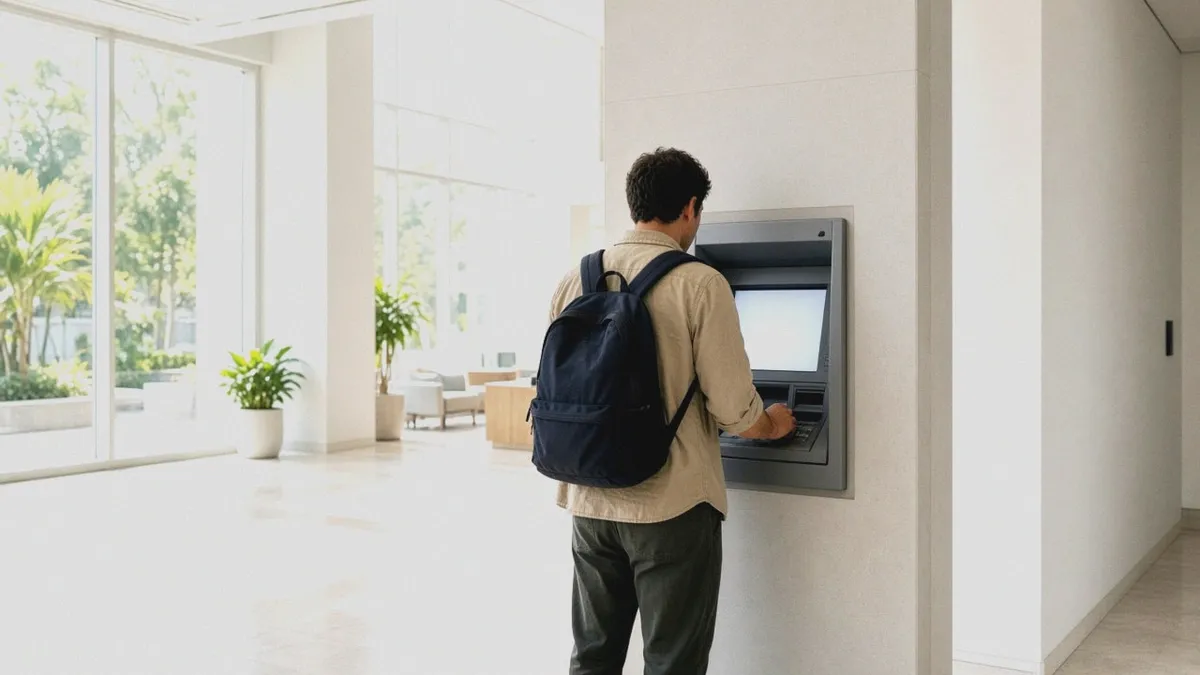
Thai bank ATMs charge a flat fee for every withdrawal on a foreign card. Under the major banks' published tariffs in late 2026, it's 250 baht on Visa and UnionPay cards and 350 baht on Mastercard, plus any fee your own bank adds. Older guides still quote 220 baht, which is out of date.
Because the fee is flat, small withdrawals are expensive: 250 baht on a 5,000-baht withdrawal is 5%, but on 20,000 baht it's about 1.25%. Some banks cap a single withdrawal at around 20,000 baht.
How to keep ATM costs down:
- Withdraw larger amounts less often, and keep the cash split between your wallet and your room safe.
- Decline the conversion offer. If the ATM or card machine offers to charge you in your home currency, refuse and choose baht. The machine's exchange rate is usually worse than your card's.
- Use ATMs inside or beside banks, cover your PIN, and check the card slot for anything loose. Card skimming does happen.
- Carry two cards from different banks and keep them in separate places.
- Tell your bank you're travelling so they don't block your card.
Cards vs cash: what to use where
Visa, Mastercard, UnionPay and JCB cards are widely accepted in hotels, malls, chain restaurants, attractions and for online bookings. Contactless payment is increasingly common in cities.
Use cash for: street food and markets (including Chiang Mai's Sunday Walking Street), red songthaews and tuk-tuks, small family-run restaurants and guesthouses, temple donations, national park and village fees, and tips.
Use a card for: hotels, malls, larger restaurants, flights, trains and booking tours online. Some small businesses add a 2–3% surcharge for cards.
How much cash to carry depends on your style. As a rough guide for Chiang Mai in 2026, a budget traveller might spend 800–1,200 baht a day in total, much of it in cash, while mid-range travellers pay more by card.
Paying by QR code: Thai QR and PromptPay for tourists
Thailand's national PromptPay and Thai QR system is everywhere, from department stores to fruit stalls. Normally you need a Thai bank account to pay this way, but there are options for visitors:
- Cross-border QR: visitors with banking apps from Singapore (PayNow), Japan, Indonesia (QRIS), Malaysia (DuitNow), Cambodia (KHQR), Vietnam, Laos and Hong Kong can scan Thai QR codes directly, with the amount converted from their home account.
- Alipay and WeChat Pay: accepted at many shops through providers approved by the Bank of Thailand.
- Tourist wallets and prepaid cards that can pay Thai QR codes are also available.
If you can't pay by QR, just ask "cash OK?" Vendors are used to it.
Tipping in Thailand
Tipping isn't compulsory, but it's appreciated. Many hotels and sit-down restaurants already add a 10% service charge to the bill. Where there's no service charge, rounding up or leaving 20–100 baht is common. For a massage, 50–100 baht is a typical thank-you. On a day tour, if your guide and driver look after you well, a tip of a few hundred baht for the group is a kind gesture, but never expected. These are customary amounts, not rules.
Bargaining at markets
Polite bargaining is normal at markets and handicraft stalls, but not in shops with fixed price tags, malls, 7-Eleven or restaurants. Smile, ask "lot dai mai?" (ลดได้ไหม, "can you reduce it?"), and accept a fair price. A few baht matter more to the vendor than to you.
VAT refund for tourists
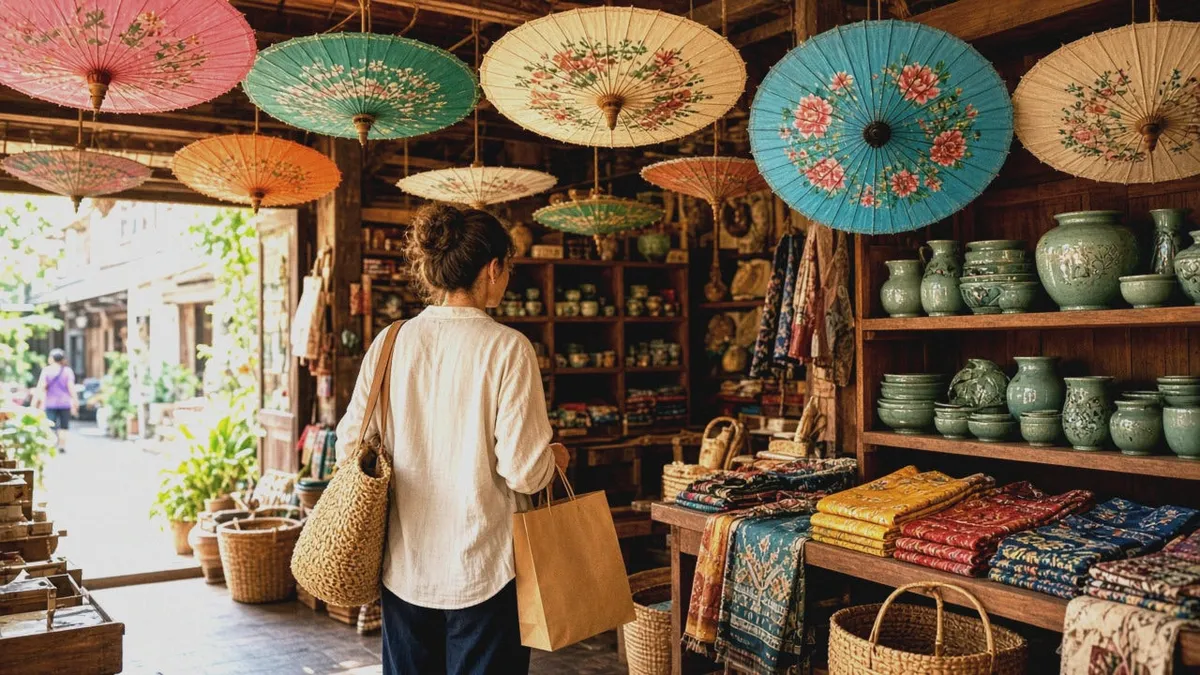
Thailand adds 7% VAT to most goods. Foreign visitors who leave by air from an international airport can claim it back on goods they take home. The Revenue Department's rules:
- Shop at stores showing the "VAT REFUND FOR TOURISTS" sign.
- Spend at least 2,000 baht (VAT included) in the same store on the same day, show your passport, and ask for the VAT refund form (P.P.10 or the electronic e-P.P.10) with the original tax invoices.
- Take the goods out of Thailand within 60 days of purchase.
- At the airport, before check-in: if your purchases total 20,000 baht or more, show the goods, forms and invoices to Customs for a stamp. Expensive items such as jewellery, watches, phones, laptops and designer bags worth 40,000 baht or more each must be carried by hand and shown again after passport control.
- After immigration: hand in your forms at the VAT Refund for Tourists office. Refunds of up to 30,000 baht can be paid in cash (baht) or to Alipay or WeChat Pay; larger refunds go to a credit card.
VAT refund counters operate at 10 international airports, including Chiang Mai, Suvarnabhumi, Don Mueang, Phuket, Krabi, Samui and Chiang Rai. You can't claim back VAT on hotels, restaurants or anything you use up during your stay, and you can't claim if you leave Thailand by land.
Quick money checklist
- One or two cards with low foreign-transaction fees, plus a backup card kept separately.
- A little home currency in clean, large notes to exchange in town.
- Your passport for currency exchange and VAT refunds.
- Small notes for markets, songthaews and tips.
- Always pay and withdraw in baht.
Spend on experiences
Most Chiang Mai tours on Connect Booking can be booked online by card, so you don't need to carry a big wad of cash into the hills. A half-day visit with Chiang Mai Secret Elephant is an easy, no-riding morning or afternoon with rescued elephants. For more adventure, the Ultimate Elephant, ATV and Zipline experience packs a full day. Keep some small notes for snacks and tips.
Frequently asked questions
Is it better to exchange money before going to Thailand?
Usually not. Rates at licensed money changers in Thai cities are generally better than at home or at airport arrival halls. Change a little at the airport and the rest in town.
What is the best way to get Thai baht?
Use a low-fee card at a bank ATM for larger, less frequent withdrawals, or exchange clean, large notes at a licensed money changer in town. Bring your passport.
How much are ATM fees in Thailand?
As of late 2026, Thai bank ATMs typically charge foreign cards 250 baht per withdrawal on Visa and UnionPay and 350 baht on Mastercard, plus any fee from your own bank.
Can tourists use PromptPay in Thailand?
Not without a Thai bank account, but visitors with banking apps from eight linked markets, including Singapore, Japan, Malaysia and Hong Kong, can scan Thai QR codes. Alipay and WeChat Pay also work at many shops.
Do you tip in Thailand?
It isn't required. Many restaurants add a 10% service charge. Otherwise rounding up or leaving a small tip for good service is appreciated.
How do I get a VAT refund in Thailand?
Spend at least 2,000 baht in one store on the same day at a shop with the VAT Refund for Tourists sign, get the P.P.10 form and invoices, and claim at the airport when you fly out within 60 days.
Start planning
With a card, a little cash in small notes and the baht-not-home-currency rule, money is the easy part of a Thailand trip. When you're ready, browse Chiang Mai tours on Connect Booking and book your days out in advance.
Fees, rates and limits are approximate as of 2026 and can change. Facts checked November 2026.
Sources
- AM2026 Thailand (government site) — means of payment (cards, Thai QR, cross-border QR markets, Alipay/WeChat Pay) — https://www.am2026thailand.go.th/means-of-payment — accessed 16 November 2026
- Bank of Thailand — PromptPay and Thai QR Payment — https://www.bot.or.th/en/financial-innovation/digital-finance/digital-payment/promptpay.html — accessed 16 November 2026
- Thaipedia — ATM fees in Thailand (KBank, Bangkok Bank, SCB, Krungsri, Krungthai tariffs; 220 baht outdated; Krungthai 20,000-baht limit), checked 19 October 2026 — https://thaipedia.asia/en/living/money/atm-fees/ — accessed 16 November 2026
- ThaiRate — Where to change money in Thailand: airport, city, bank or hotel (rate gaps, passport ID, Suvarnabhumi basement level) — https://thairate.com/en/guide/where-to-change-money-in-thailand/ — updated 16 November 2026; accessed 16 November 2026
- UK FCDO — Thailand safety and security (card fraud and skimming) — https://www.gov.uk/foreign-travel-advice/thailand/safety-and-security — accessed 16 November 2026
- Thai Customs Department — Guidelines for Airport Passengers — https://www.customs.go.th/list_strc_simple_neted.php?ini_content=individual_160503_03_160905_01&lang=en&left_menu=menu_individual_submenu_01_160421_01 — accessed 16 November 2026
- Thai Customs Department — Citizen's manual: bringing currency into and out of Thailand (foreign currency over US$15,000 must be declared; Thai, 2026) — https://www.customs.go.th/data_files/8c2292dc43649a7cacd6a57687b47de4.pdf — accessed 16 November 2026
- The Revenue Department — VAT Refund for Tourists conditions — https://vrtweb.rd.go.th/81.html — accessed 16 November 2026
- The Revenue Department — VAT Refund for Tourists FAQ (10 airports, services excluded, refund payment methods) — https://vrtweb2.rd.go.th/69.html — accessed 16 November 2026
- Travel Dojo — Chiang Mai travel costs (daily budget ranges) — https://www.traveldojo.com/chiang-mai/costs/ — accessed 16 November 2026