Thailand SIM Card and eSIM for Tourists (2026): Prices, Passport Rules and Where to Buy
By Connect Booking 9 min read

Tourist SIM or eSIM for Thailand? 2026 prices from AIS and True, the passport and face-scan rule, where to buy on arrival and when a travel eSIM is better.
The quickest way to get online in Thailand is a tourist SIM or eSIM from one of the two big networks, AIS or True (which now also runs dtac). As of November 2026, an 8-day unlimited-data tourist package costs about 499 baht on either network, and a 30-day package about 1,199 baht. The one rule to remember: a Thai number must be registered in person with your original passport and a live face scan. If you'd rather skip that step, a data-only travel eSIM bought before you fly is the alternative. Here's how to choose.
Tourist SIM prices in Thailand (2026)
Both networks sell special packages for visitors with unlimited data at full speed, usually on 5G where available. Prices below are from the operators' own tourist pages as of 2026; they change often, so check before you buy.
AIS tourist SIM
- 1 day: 49 baht, 1 GB at 10 Mbps
- 5 days: 399 baht, unlimited data
- 8 days: 499 baht, unlimited data
- 15 days: 699 baht, unlimited data (AIS's best seller)
- 30 days: 1,199 baht, unlimited data
- 60 days: 1,599 baht, unlimited data
The longer AIS packages also include free calls within the AIS network and AIS Wi-Fi hotspots.
True (TrueMove H and dtac) tourist SIM
- Tourist Infinite SIM, 8 days: 499 baht
- 15 days: 699 baht
- 30 days: 1,199 baht
- Tourist SIM, 10 days (data only): about 349 baht
True's Infinite packages include unlimited 5G/4G data, free calls to all Thai networks (up to 15 minutes per call), access to True and dtac Wi-Fi hotspots, and some credit for international calls. True says its prices include VAT.
Which network is best? Both cover Chiang Mai, Bangkok and the main islands well. AIS is often recommended for coverage in the mountains and rural north, but signal varies valley by valley, so don't expect bars everywhere on a jungle trek. For a typical one- or two-week holiday the 8- or 15-day package is enough.
The passport rule: register in person
Thailand doesn't sell anonymous SIM cards. Since 18 August 2025, every new prepaid or postpaid number has been registered with an identity check that includes a live face scan. For visitors that means:
- Bring your original passport. A photo or photocopy is not accepted.
- Register the SIM yourself. Don't use a number registered in someone else's name.
- Up to three numbers per person per network. True's terms state this limit for tourist SIMs.
Tourist SIMs also have a hard limit: they last no more than 60 days. True says its tourist SIMs can't be extended by topping up after the package expires; you'd need to re-register with your passport at a shop. AIS asks visitors who want to keep a tourist SIM beyond 60 days to confirm their identity again, either by texting their passport number to 4444161 or by visiting an AIS shop.
Where to buy a SIM card in Thailand
- At the airport: network counters in the international arrivals halls are the easiest option on day one. Staff register the SIM, install it and check it works before you leave. Queues can be long when several flights land together.
- Network shops in town: AIS and True shops in shopping malls in Bangkok, Chiang Mai and the islands sell the same packages and can help if something goes wrong later.
- Convenience stores: some sell SIM cards, but registration with passport and face scan still applies. For a tourist package, an official network shop or airport counter is simpler.
Wherever you buy, ask the staff to confirm the package is active and test mobile data before you walk away.
eSIM options: local eSIM vs travel eSIM
There are two very different kinds of eSIM for Thailand.
1. A Thai tourist eSIM from AIS or True
AIS and True both sell their tourist packages as eSIMs, with a real Thai phone number. You avoid swapping a plastic card, but the passport registration still applies: you complete the identity step in the network's app or at a shop.
2. A travel eSIM bought before you fly
International travel eSIM sellers offer Thailand data plans that you install at home over Wi-Fi and switch on when you land. They connect as a roaming guest on a Thai network.
- Pros: data the moment you land (useful for booking a ride from the airport), no queue, and your home SIM stays in the phone for bank verification texts.
- Cons: usually data only with no Thai phone number, often more expensive than a local package, and "unlimited" plans may slow down after a daily allowance.
As of November 2026 we could not find an official Thai rule requiring roaming travel eSIMs to be registered, but rules can change, so check the seller's conditions.
Before you buy any eSIM, make sure your phone supports eSIM and is unlocked (not tied to your home network).
Do you need a Thai phone number?
Not always, but it helps. A Thai number makes it easier for drivers, guesthouses and tour operators to call you, and some local services expect one. If you're staying a week or more, or travelling outside the big cities, a local SIM or Thai eSIM is the practical choice. For a short city break, a data-only travel eSIM plus messaging apps is usually fine.
Emergency numbers work from any phone: 1155 for the Tourist Police (24 hours, several languages), 191 for police and 1669 for emergency medical services. The official Thailand Tourist Police app is also useful if you don't have a Thai SIM.
Using your data in Chiang Mai and the north

Once you're connected, you'll use your phone for almost everything:
- Maps and ride-hailing: Grab and Bolt work across Chiang Mai, and drivers can find you more easily if they can call or message you.
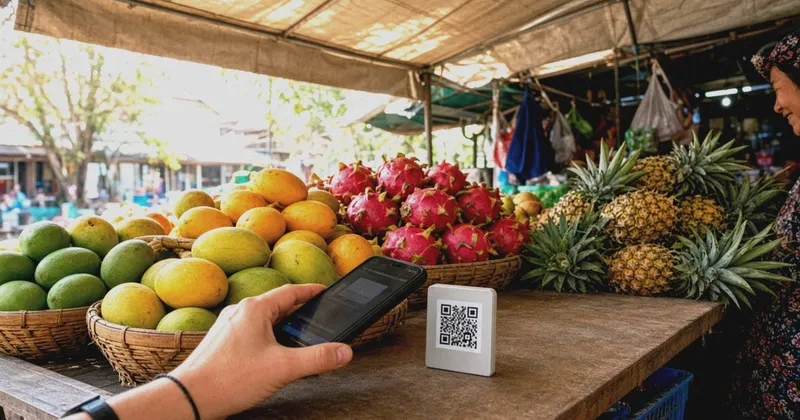
- Payments: many shops and stalls display a Thai QR code. Visitors from some countries can scan it with their home banking app.
- Air quality: from roughly February to April, check the daily PM2.5 reading before outdoor plans (the government Air4Thai app is a good start).
- Tours: keep your booking confirmation and meeting-point details offline as screenshots, because mountain roads and forest trails can have weak signal.
Download offline maps of Chiang Mai and anywhere you're trekking, and carry a small power bank: navigation and photos drain batteries fast on a long day out.
Quick checklist before you fly
- Check your phone is unlocked and supports eSIM (if you want one).
- Decide: Thai tourist SIM/eSIM (cheaper, Thai number) or travel eSIM (no queue, data only).
- Keep your passport in your hand luggage for registration at the airport.
- Turn off data roaming on your home SIM to avoid surprise charges.
- Save the emergency numbers 1155, 191 and 1669.
- Read our Thailand entry requirements checklist so you have your documents ready, too.
Stay connected on your tours
Mobile signal fades in the mountains, so tell someone your plans for the day. On guided tours, the guide handles navigation and timing. A guided 1-day trek in Doi Inthanon National Park takes you onto forest trails where you won't need your maps app. A half-day ethical elephant care and herbal wellness visit, with no riding, leaves the rest of the day free for exploring the city.
Frequently asked questions
What is the best SIM card for tourists in Thailand?
AIS and True both sell tourist SIMs with unlimited data. As of 2026 the 8-day package costs about 499 baht on either network. AIS is often preferred for rural coverage in the north.
Can I buy a Thai SIM card without a passport?
No. A Thai number must be registered with your original passport and a live face scan. A data-only travel eSIM bought abroad doesn't give you a Thai number.
Is an eSIM better than a SIM card in Thailand?
A travel eSIM gives you data as soon as you land with no queue, but it's usually data only and costs more. A Thai tourist SIM or eSIM is cheaper and includes a Thai number.
How much is a tourist SIM at Bangkok or Chiang Mai airport?
As of 2026, tourist packages cost about 399–1,599 baht at AIS and 349–1,199 baht at True, depending on length. Prices change, so check at the counter.
How long does a Thai tourist SIM last?
The longest tourist packages are 30 days (True) or 60 days (AIS). Tourist SIMs can't be used beyond 60 days without registering your identity again.
Can I use my phone's Wi-Fi calling and messaging apps in Thailand?
Yes. Messaging and calling apps work over mobile data or Wi-Fi. Hotels, cafés and many malls have free Wi-Fi.
Start planning
Sort your SIM or eSIM before you land and you'll be booking rides, finding street food and sharing photos from the first hour. When you're ready for the hills, browse Chiang Mai tours on Connect Booking.
Prices are approximate as of 2026 and can change. Facts checked November 2026.
Sources
- AIS — SIM and plans for tourists (prices, 60-day re-verification by SMS 4444161) — https://www.ais.th/en/consumers/package/international/tourist-plan — accessed 16 November 2026
- True-dtac — Thailand tourist SIM and eSIM (prices incl. VAT, 3 SIMs per person per brand, 60-day maximum validity) — https://www.true.th/en/prepaid/sim/tourist — accessed 16 November 2026
- ThailandTested — Thailand SIM card and eSIM (identity check with liveness detection since 18 August 2025; True 349-baht 10-day Tourist SIM) — https://thailandtested.com/guides/thailand-sim-esim/ — accessed 16 November 2026
- POVNOMAD — Thailand SIM card for tourists (operator price table 10 October 2026; travel eSIM roaming and registration note) — https://povnomad.com/en/thailand-sim-card-for-tourists/ — accessed 16 November 2026
- Tourist Police Bureau — Tourist Police 1155 and Thailand Tourist Police app — https://www.touristpolice.go.th/en/post/tpbnews2026102203 — published 22 October 2026; accessed 16 November 2026
- UK FCDO — Thailand health (emergency medical number 1669) — https://www.gov.uk/foreign-travel-advice/thailand/health — accessed 16 November 2026
- AM2026 Thailand (government site) — means of payment (Thai QR and cross-border QR) — https://www.am2026thailand.go.th/means-of-payment — accessed 16 November 2026
- PRD, citing the Ministry of Public Health — PM2.5 in northern provinces — https://thailand.prd.go.th/en/content/category/detail/id/43/cid/2078/iid/492150 — published 7 April 2026; accessed 16 November 2026